19  Duration Models

In political science, it’s common to model duration outcomes. We’ll use two standard examples.

  1. time in the cancer data set (see ?survival::cancer). This is the patient’s survival time in days.
  2. duration in the coalition data set (see?ZeligData::coalition). This is the government duration in months.

19.1 Exponential Model

We might model time in the cancer dataset using an exponential distribution.

canc <- survival::cancer |>
  mutate(sex = case_when(sex == 1 ~ "Male",
                         sex == 2 ~ "Female"))

glimpse(canc)
Rows: 228
Columns: 10
$ inst      <dbl> 3, 3, 3, 5, 1, 12, 7, 11, 1, 7, 6, 16, 11, 21, 12, 1, 22, 16…
$ time      <dbl> 306, 455, 1010, 210, 883, 1022, 310, 361, 218, 166, 170, 654…
$ status    <dbl> 2, 2, 1, 2, 2, 1, 2, 2, 2, 2, 2, 2, 2, 2, 2, 2, 2, 2, 2, 2, …
$ age       <dbl> 74, 68, 56, 57, 60, 74, 68, 71, 53, 61, 57, 68, 68, 60, 57, …
$ sex       <chr> "Male", "Male", "Male", "Male", "Male", "Male", "Female", "F…
$ ph.ecog   <dbl> 1, 0, 0, 1, 0, 1, 2, 2, 1, 2, 1, 2, 1, NA, 1, 1, 1, 2, 2, 1,…
$ ph.karno  <dbl> 90, 90, 90, 90, 100, 50, 70, 60, 70, 70, 80, 70, 90, 60, 80,…
$ pat.karno <dbl> 100, 90, 90, 60, 90, 80, 60, 80, 80, 70, 80, 70, 90, 70, 70,…
$ meal.cal  <dbl> 1175, 1225, NA, 1150, NA, 513, 384, 538, 825, 271, 1025, NA,…
$ wt.loss   <dbl> NA, 15, 15, 11, 0, 0, 10, 1, 16, 34, 27, 23, 5, 32, 60, 15, …
We can use covariates to either model the rate \(\lambda\) or the mean \(\mu = \frac{1}{\lambda}\). survival::survreg() models the mean, so that

\[ t_i \sim \text{exponential}( \lambda_i), \qquad i = 1, \dots, n, \]

with rate \(\lambda_i = \frac{1}{\mu_i}\) and \(\mu_i =\exp\!\left(-X_i \beta\right)\), where \(x_i\) is the covariate vector (including intercept, age, sex, and ph.karno). For this parameterization, positive coefficients increase the mean and decrease the rate (i.e., shorter expected survival).

flexsurv::flexsurvreg() uses a different parameterization that models the rate directly (rather than the mean), so that

\[ t_i \sim \text{exponential}(\lambda_i), \qquad i = 1, \dots, n, \]

with \(\lambda_i = \exp\!\left(-X_i \beta\right)\). In this parameterization, a positive coefficient increases the rate and decreases the mean (i.e., shorter expected survival) .

We can use the survreg() function in the {survival} package to fit the exponential regression model to the cancer data. For the survreg() function, we need to wrap the outcome in the Surv() function. This is unusual, but the reason will become clear in a bit.

# load package
library(survival)

# fit model
f <- Surv(time) ~ age + sex + ph.karno  # notice the Surv(time) bit...
fit_exp <- survreg(f, data = canc, dist = "exp")

# create table of coefs
modelsummary(fit_exp)
(1)
(Intercept) 5.522
(0.728)
age -0.004
(0.008)
sexMale -0.167
(0.136)
ph.karno 0.006
(0.005)
Num.Obs. 227
AIC 3057.0
BIC 3070.7
RMSE 206.52

19.1.1 QIs

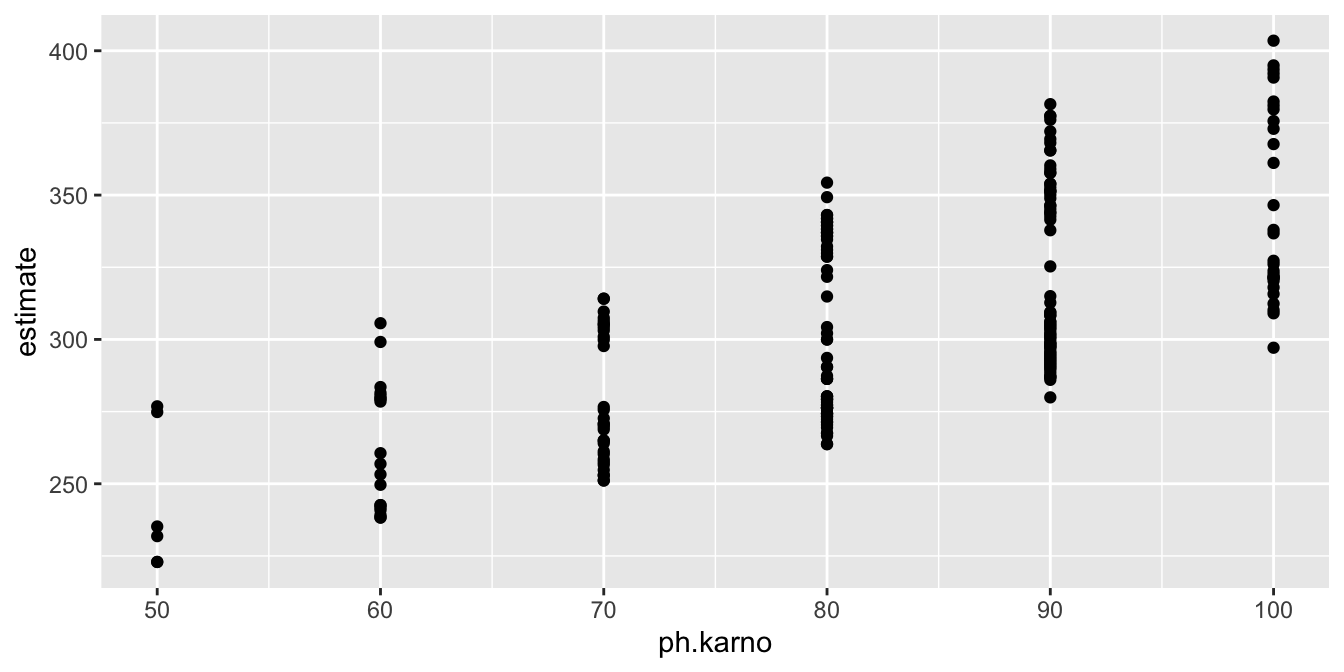
We can use {marginaleffects} to compute the expected values for every row in the dataset.

p <- predictions(fit_exp)
ggplot(p, aes(x = ph.karno, y = estimate)) + 
  geom_point()

We can also compute the average change in the duration as ph.karno changes from the 25th percentile to the 75th percentile.

summary(canc$ph.karno)
   Min. 1st Qu.  Median    Mean 3rd Qu.    Max.    NA's 
  50.00   75.00   80.00   81.94   90.00  100.00       1 
avg_comparisons(fit_exp, 
            variables = list(ph.karno = c(75, 90)))

 Estimate Std. Error    z Pr(>|z|)   S 2.5 % 97.5 %
       29       24.5 1.18    0.237 2.1 -19.1   77.1

Term: ph.karno
Type: response
Comparison: 90 - 75

Or we could compute the lift!

avg_comparisons(fit_exp, 
            variables = list(ph.karno = c(75, 90)), 
            comparison = "lift")

 Estimate Std. Error    z Pr(>|z|)   S   2.5 % 97.5 %
   0.0994     0.0875 1.14    0.256 2.0 -0.0721  0.271

Term: ph.karno
Type: response
Comparison: liftavg

19.2 Two Problems

  1. First, we have censoring. If someone is still alive at the end of our study, they didn’t live X days, they lived longer than X days.
  2. Second, maybe the exponential distribution isn’t the best match to the data… are there others?

19.2.1 Censoring

It seems like the data collection for the cancer study lasted about 1,000 days.

  • If patients were still alive at the end of the study, then time was recorded as the number of days they survived so far and status was coded as 1.
  • If patients died during the study, then time was recorded as the number of days they survived and status was coded as 2.

19.2.1.1 Usual Likelihood

Let’s let \(y_i = t_i\) for this type of data, since we think of the outcome as the time something lasts. Let’s model the outcome using an exponential distribution \[ t_i \sim \text{exponential}(\lambda_i) \] mean1 using

1 Recall that flexsurv::flexsurvreg() models the rate instead, for example.

\[ \lambda_i = \frac{1}{\mu_i}; \quad\mu_i = \exp(X_i\beta) \]

We can write the likelihood as the product of exponential pdfs, so that

\[ L(\beta; t) = \prod_{i=1}^N \frac{1}{\exp(X_i\beta)} e^{-\frac{t_i}{\exp(X_i\beta)}}. \]

Then the log-likelihood function is

\[\begin{aligned} \log L(\beta; t) &= \log \left( \prod_{i=1}^N \frac{1}{\exp(X_i\beta)} e^{-\tfrac{t_i}{\exp(X_i\beta)}} \right) \\[6pt] &= \sum_{i=1}^N \log \left( \frac{1}{\exp(X_i\beta)} \right) + \sum_{i=1}^N \log \left( e^{-\tfrac{t_i}{\exp(X_i\beta)}} \right) \\[6pt] &= -\sum_{i=1}^N X_i\beta - \sum_{i=1}^N \frac{t_i}{\exp(X_i\beta)}. \end{aligned}\]

But importantly, this likelihood is wrong for censored observations.

19.2.1.2 Adjusting for Censoring

The survivor function \(S(t) = 1 - F(t)\) is defined as the probability of an event not occurring by time \(t\) (or occurring after time \(t\)).

For the exponential distribution, the survivor function is

\[ S(t) = \int_{t}^\infty f(t) dt= \int_{t}^\infty \frac{1}{\mu_i} e^{-\frac{t}{\mu}} dt = e^{-\frac{1}{\mu} t} \] Given data with uncensored and right-censored observations:

  • Uncensored: \(\frac{1}{\mu_i} e^{-\frac{1}{\mu_i} t_i}\) for each observation at \(t_i\)
  • Right-censored: \(e^{-\frac{1}{\mu_i} t_i^*}\) for each censored observation at \(t_i^*\)

Then we have the likelihood accounting for censoring

\[ L = \prod_{\text{uncensored } i} \overbrace{\left( \frac{1}{\mu_i} e^{-\frac{1}{\mu_i} t_i} \right)}^{\text{density}} \times \prod_{\text{right-censored } j} \overbrace{\left( e^{-\frac{1}{\mu_i} t_j^*} \right)}^{\text{probability}} \]

Taking the log, we have

\[ \log L = \sum_{\text{uncensored } i} \left( \log \frac{1}{\mu_i} - \frac{1}{\mu_i} t_i \right) + \sum_{\text{right-censored } j} \left( -\frac{1}{\mu_i} t_j^* \right) \]

Then we can substitute \(\mu_i = \exp(X_i \beta)\) and be on our way as usual.

Censoring is very common in duration models, so the survreg() function can easily accommodate censored observations. You simply supply a variable indicating censoring as the second argument to Surv().

Warning

Notice that status is coded as 1/2 rather than the usual 0/1. It’s worth highlighting this note from ?Surv.

The use of 1/2 coding for status is an interesting historical artifact. For data contained on punch cards, IBM 360 Fortran treated blank as a zero, which led to a policy within the Mayo Clinic section of Biostatistics to never use “0” as a data value since one could not distinguish it from a missing value. Policy became habit, as is often the case, and the use of 1/2 coding for alive/dead endured long after the demise of the punch cards that had sired the practice. At the time Surv was written many Mayo data sets still used this obsolete convention, e.g., the lung data set found in the package.

f <- Surv(time, status) ~ age + sex + ph.karno
fit_exp_cens <- survreg(f, data = canc,  dist = "exp")

We can compute our average first difference for a new model that accounts for censoring.

avg_comparisons(fit_exp_cens, 
            variables = list(ph.karno = c(75, 90)))

 Estimate Std. Error    z Pr(>|z|)   S 2.5 % 97.5 %
     85.8       41.4 2.07   0.0382 4.7  4.68    167

Term: ph.karno
Type: response
Comparison: 90 - 75

We can compare the coefficient estimates from the two models.

modelsummary(list("Censoring Not Modeled" = fit_exp, 
                  "Censoring Modeled" = fit_exp_cens))
Censoring Not Modeled Censoring Modeled
(Intercept) 5.522 6.014
(0.728) (0.847)
age -0.004 -0.011
(0.008) (0.009)
sexMale -0.167 -0.471
(0.136) (0.167)
ph.karno 0.006 0.013
(0.005) (0.006)
Num.Obs. 227 227
AIC 3057.0 2303.4
BIC 3070.7 2317.1
RMSE 206.52 276.07

And we can compute the average first difference for both models.

# create a list of models
models <- list(exp = fit_exp,
               exp_cens = fit_exp_cens)

# use map to compute for several models at once!
fd <- map_dfr(models,
  ~ avg_comparisons(.x, variables = list(ph.karno = c(75, 90))),
  .id = "model")

# show columns of interest
select(fd, model, estimate, std.error)

 Estimate Std. Error
     29.0       24.5
     85.8       41.4

19.3 Choice of Distribution

  • Like with any probability model, we need to choose a distribution for our outcome variable \(t_i\).
  • We’ve been using exponential.

We have three quantities that describe the distribution:

  • hazard function: \(h(t) = \frac{f(t)}{S(t)} = \frac{f(t)}{1 - \int_{0}^{t} f(u) \, du}\)
  • cumulative hazard function: \(H(t) = -\log(S(t)) = -\log\left(1 - \int_{0}^{t} f(u) \, du\right)\)
  • survivor function: \(S(t) = 1 - F(t) = 1 - \int_{0}^{t} f(u) \, du\)
  • original density: \(f(t) = h(t)S(t)\)

The survival::survreg() and flexsurv::flexsurvreg() functions offer numerous options via the dist argument. See their help files for the options.

Here are the distributions offered by survival::survreg().

# Exponential
fit_exp <- survreg(f, data = canc, dist = "exp")

# Log-Normal
fit_ln <- survreg(f, data = canc, dist = "lognormal")

# Weibull
fit_wei <- survreg(f, data = canc, dist = "weibull")

# Rayleigh
fit_ray <- survreg(f, data = canc, dist = "rayleigh")

# Extreme Value (Gumbel)
fit_extr <- survreg(f, data = canc, dist = "extreme")

# Gaussian (Normal)
fit_gaus <- survreg(f, data = canc, dist = "gaussian")

# Logistic
fit_logis <- survreg(f, data = canc, dist = "logistic")

# Log-Logistic
fit_llogis <- survreg(f, data = canc, dist = "loglogistic")

We can use the BIC to show that the Weibull and the log-logistic are the models for these data.

BIC(fit_exp, fit_ln, fit_wei, fit_ray, fit_extr, 
    fit_gaus, fit_logis, fit_llogis) |> 
  as_tibble(rownames = "model") |> 
  mutate(diff_min = BIC - min(BIC),
         post_prob = exp(-0.5*diff_min)/sum(exp(-0.5*diff_min))) |>
  arrange(BIC) 
# A tibble: 8 × 5
  model         df   BIC diff_min post_prob
  <chr>      <dbl> <dbl>    <dbl>     <dbl>
1 fit_wei        5 2305.     0     7.53e- 1
2 fit_llogis     5 2307.     2.24  2.45e- 1
3 fit_exp        4 2317.    12.6   1.38e- 3
4 fit_ln         5 2326.    21.5   1.66e- 5
5 fit_ray        4 2354.    50.0   1.07e-11
6 fit_logis      5 2358.    53.6   1.70e-12
7 fit_gaus       5 2364.    59.0   1.16e-13
8 fit_extr       5 2443.   139.    5.88e-31

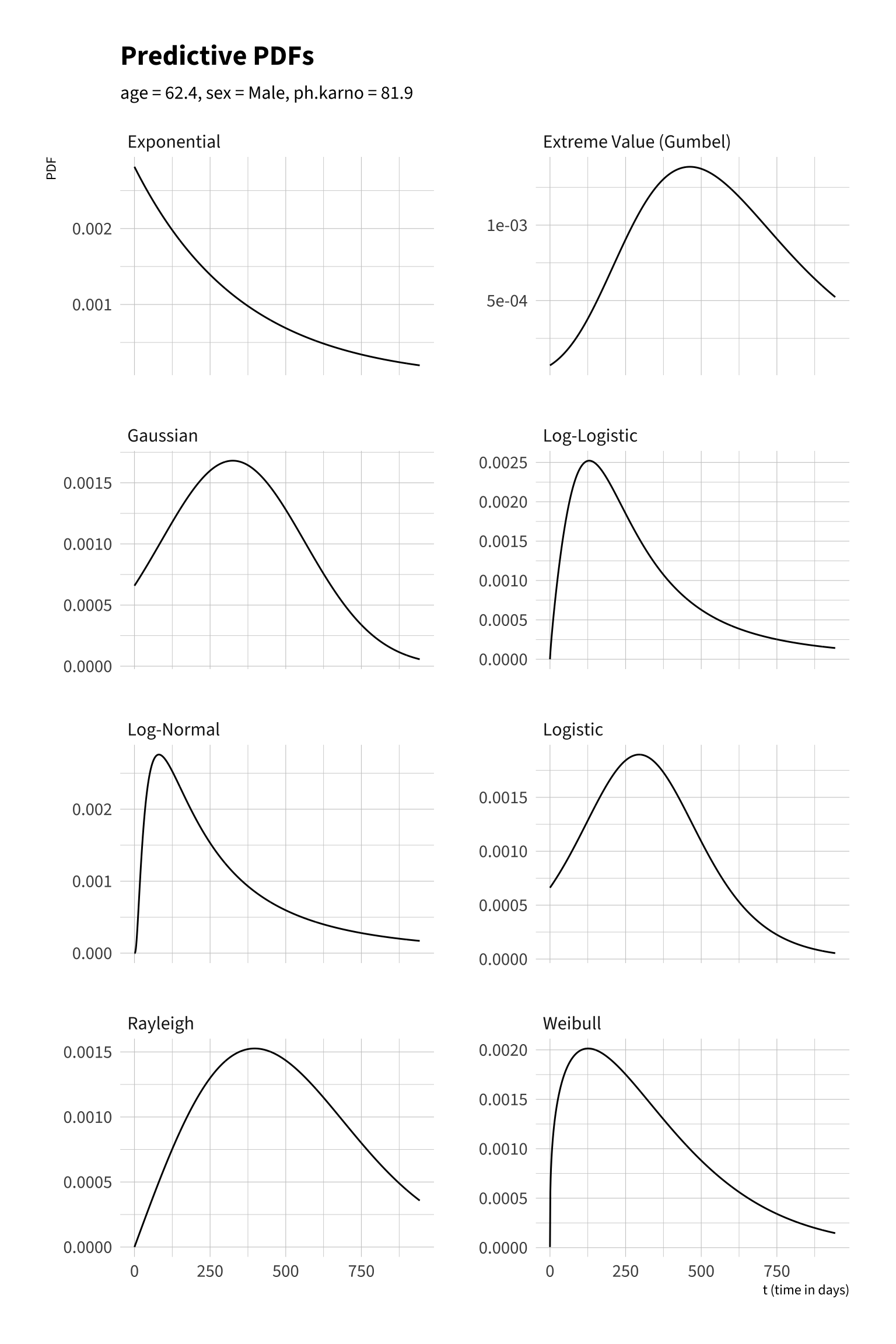
It would be worthwhile to compare the predictive distributions. Unfortunately, there’s not a simple simulate() function that works with survreg() output. However, the figure below shows the pdfs at typical values of the covariates for all the distributions above. You can see the variety of shapes that these distributions offer.

19.4 Extension: Cox PH

The choice of distributions turns out to be an important one, and it’s difficult to choose between them. To avoid this choice, researchers tend to use the semiparametric Cox proportional hazards model. It falls slightly outside our parametric framework, for now. See ch. 4 of Box-Steffensmeier and Jones (2004) for more on this standard approach.

Box-Steffensmeier, Janet M., and Bradford S. Jones. 2004. Event History Modeling: A Guide for Social Scientists. Cambridge: Cambridge University Press.